The AI Gym Busy Box
A developer workstation, a compact gym and a yoga lane in one rig. When you hand Claude Code a task, the box tells you how long you have, gives you something to do with it, and calls you back the moment the agent needs you.
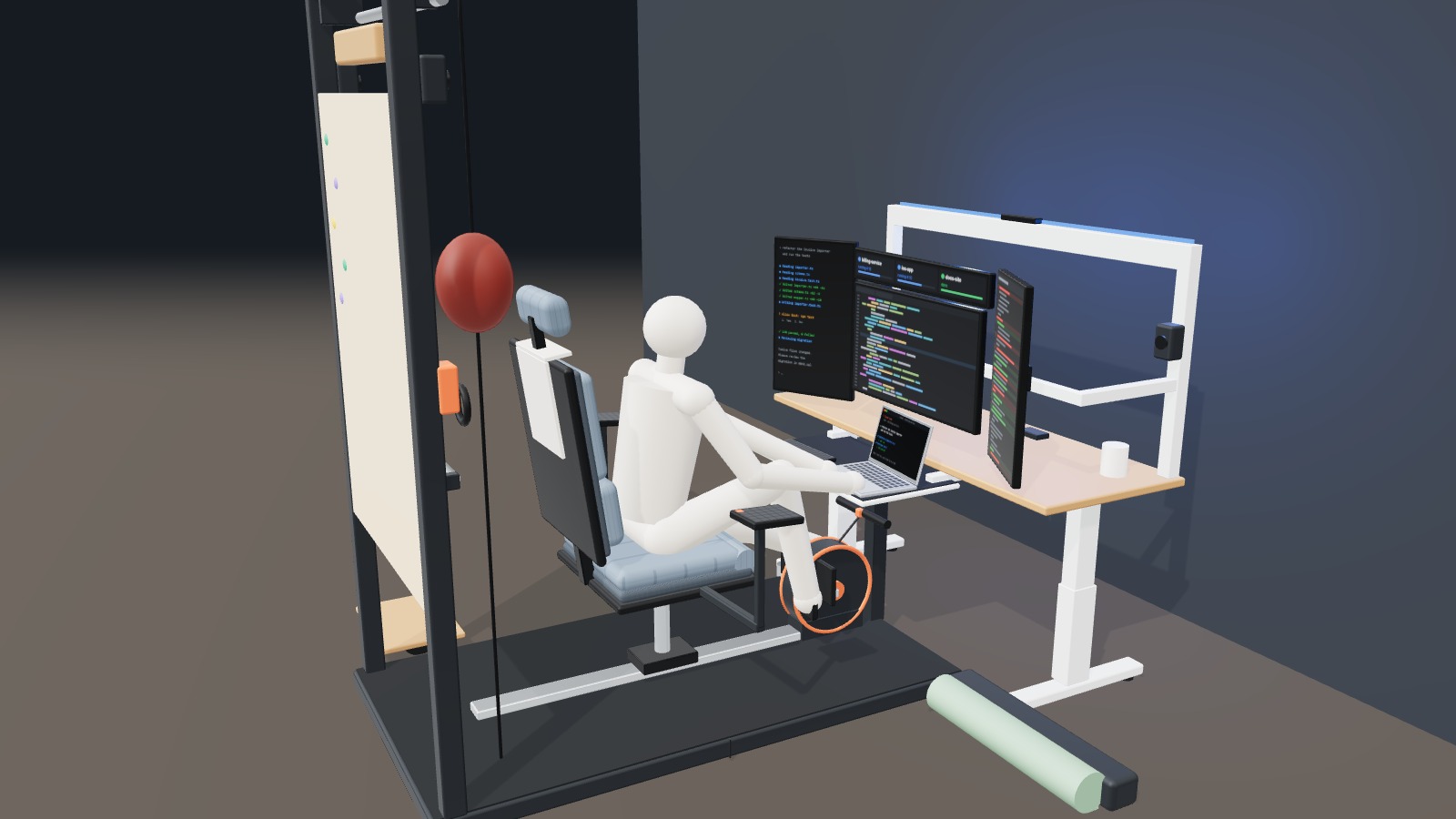
One agent run, five ways to move
The tour goes from the desk to pedaling, rowing, the strength wall and yoga, with live workout stats in the corner. The Box voice calls out the race, and chimes sound when Claude needs you and when it's done.
Try the 3D modelWork, pedal, row, lift, stretch
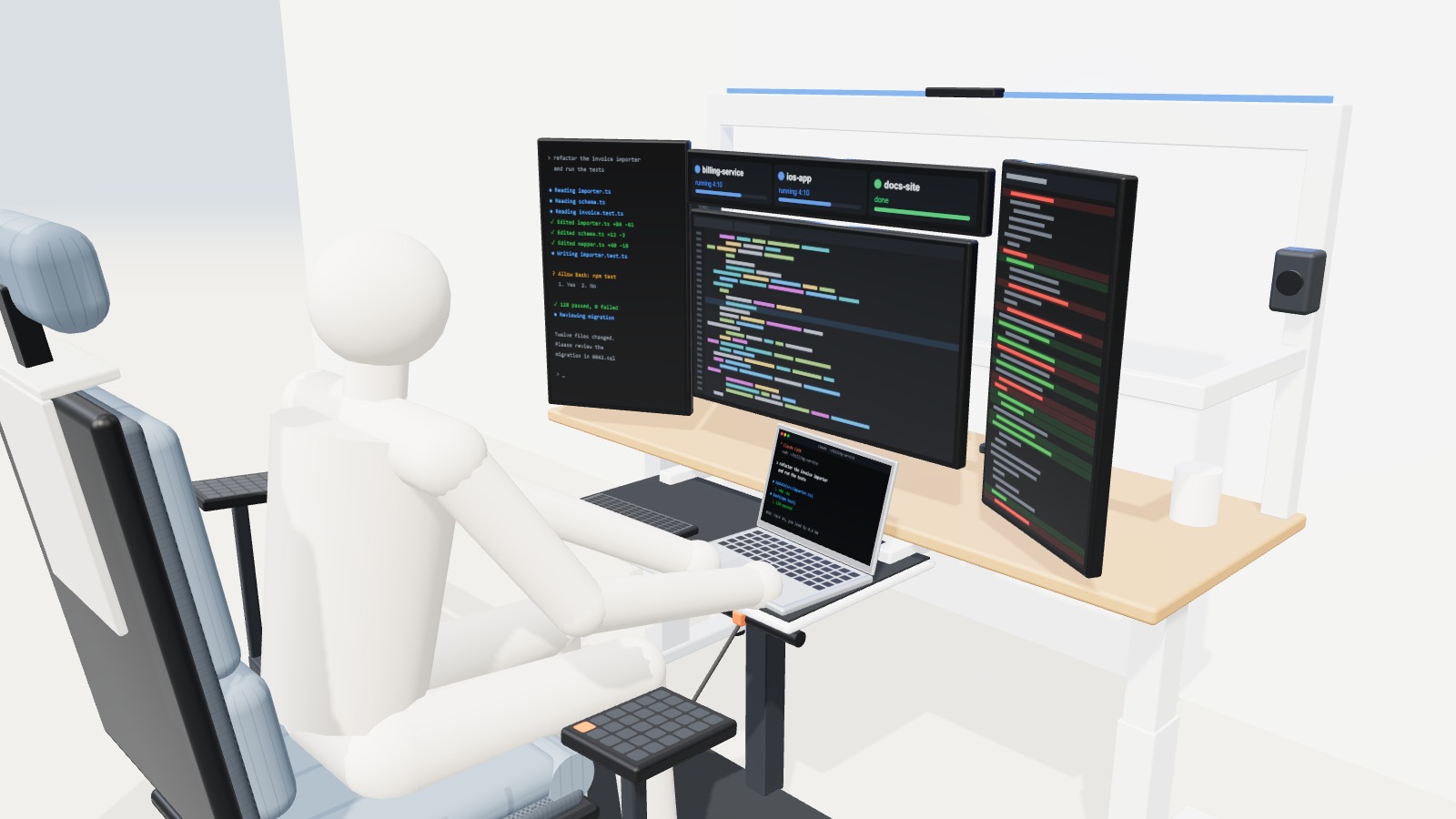
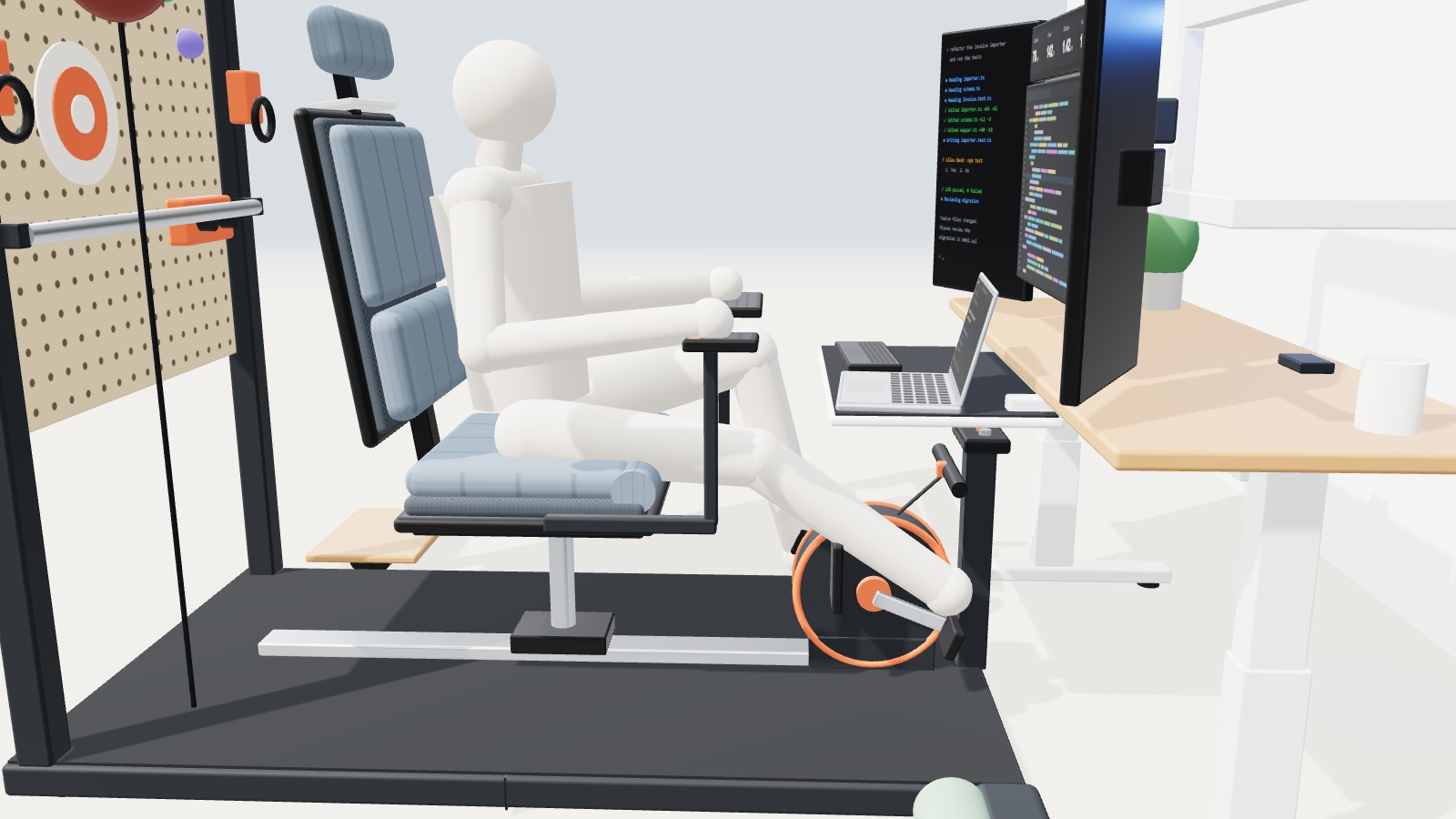
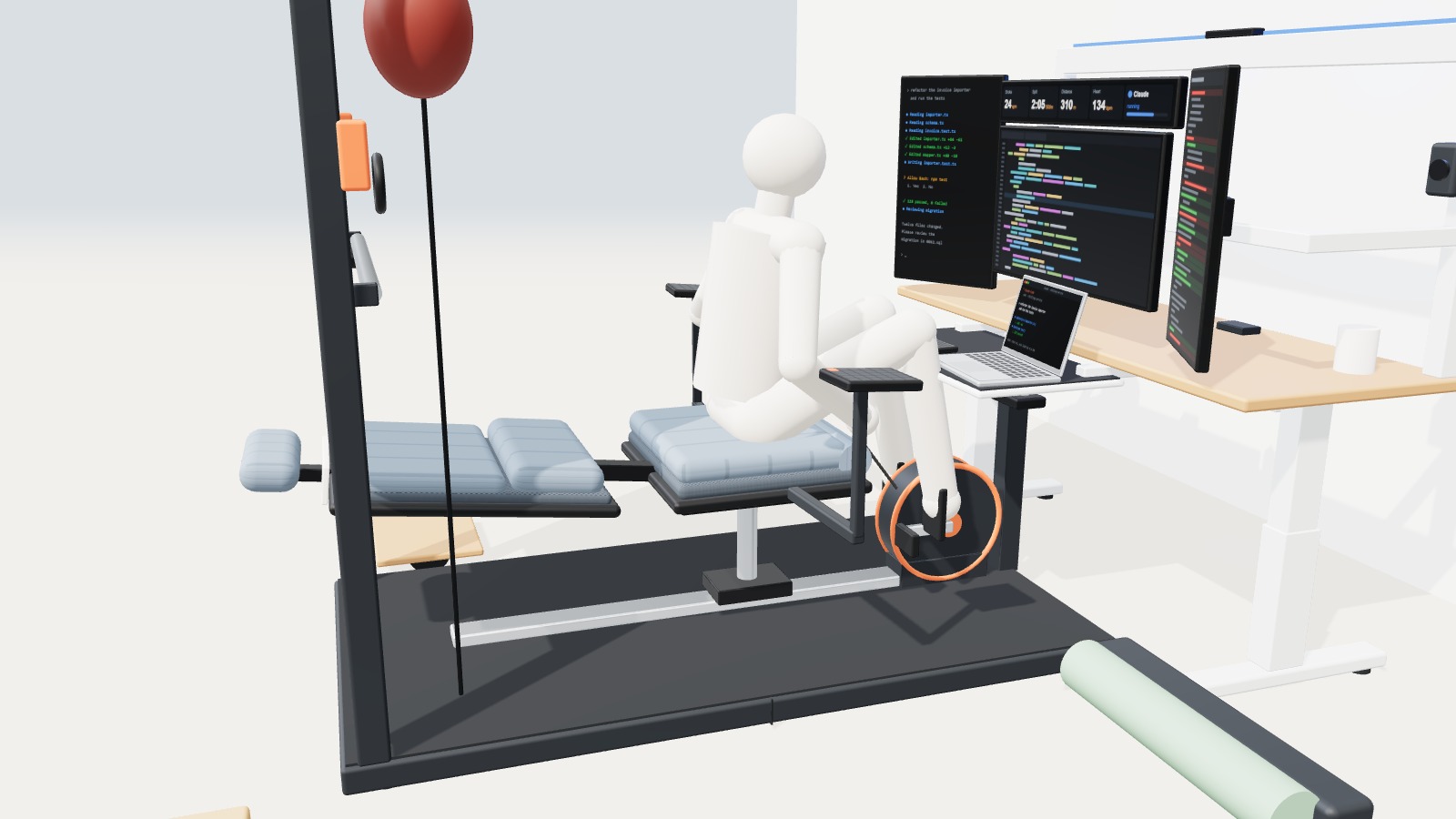
Blue means move. Amber means come back. Green means review.
Two frames, the parts that matter
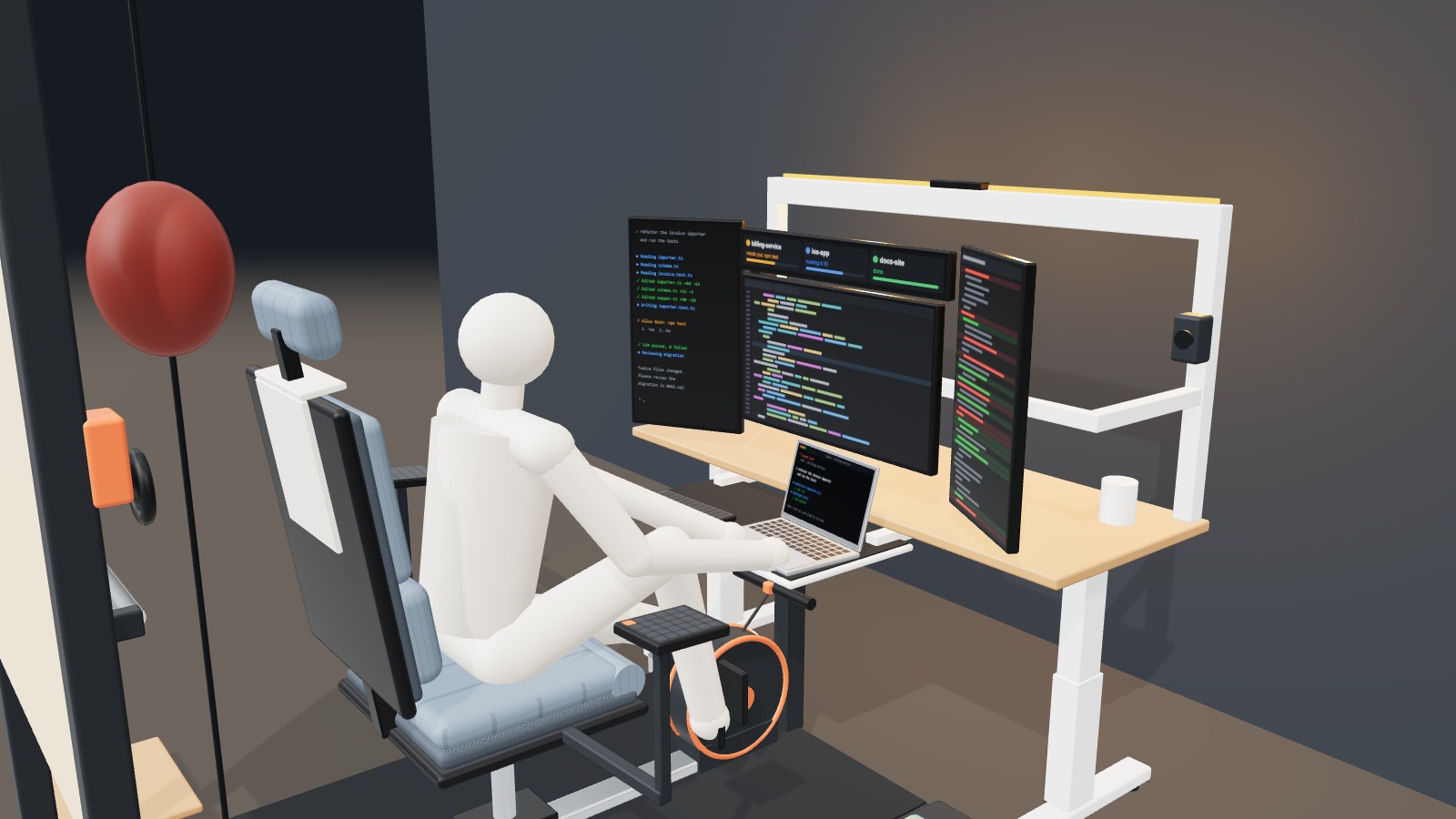
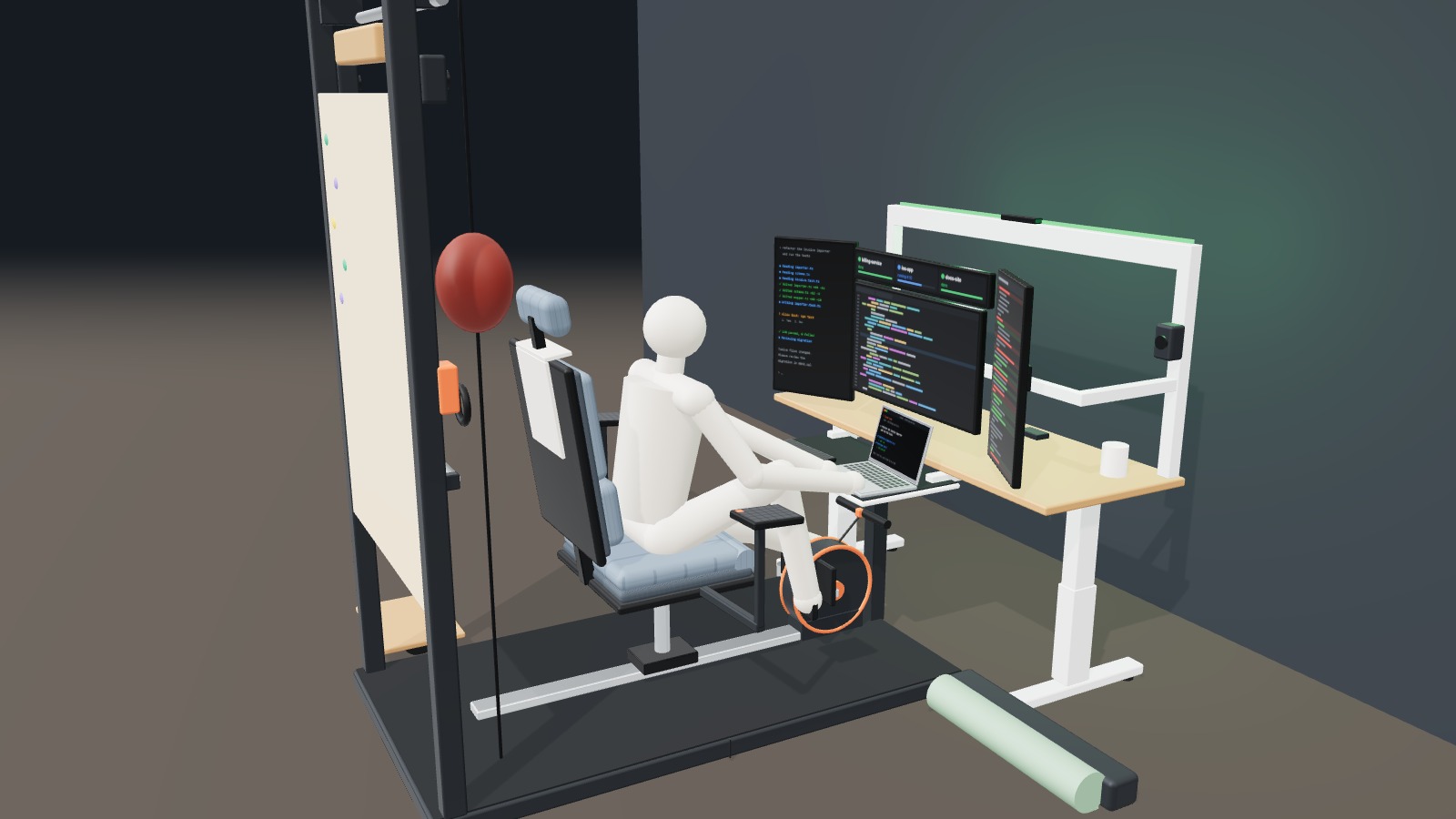
One rule shapes the whole design. Anything with pixels or electronics sits on the quiet frame. Anything you push, pull, pedal or hang from sits on the motion frame. The two never touch, so the screens stay still while you work out.
- 1Mic array and LED strip. The wall glows blue while Claude runs, amber when it needs you, green when it is done.
- 2Three monitors plus a thin status strip along the top of the main one, held forward at the desk front, about 0.9 m from your eyes. The strip shows Claude's state, and your workout stats while you move.
- 3Dual-motor lift desk, 64 to 129 cm.
- 415 mm air gap. The screens never touch anything you move on.
- 5Split keyboard on swing arms. Swings in beside your thighs for typing while you pedal; parked at the seat sides in this view.
- 6Pedal flywheel on a swing arm. Quiet enough to pedal while you type. Swing it aside to rest your feet flat. A cable spool turns it into a rower.
- 7Ventilated mesh seat on a 1.2 m rail. Stays comfortable all day and shrugs off sweat. Locks for work, slides for rowing.
- 8Cable carriage at 10 heights, 2 to 30 kg per side.
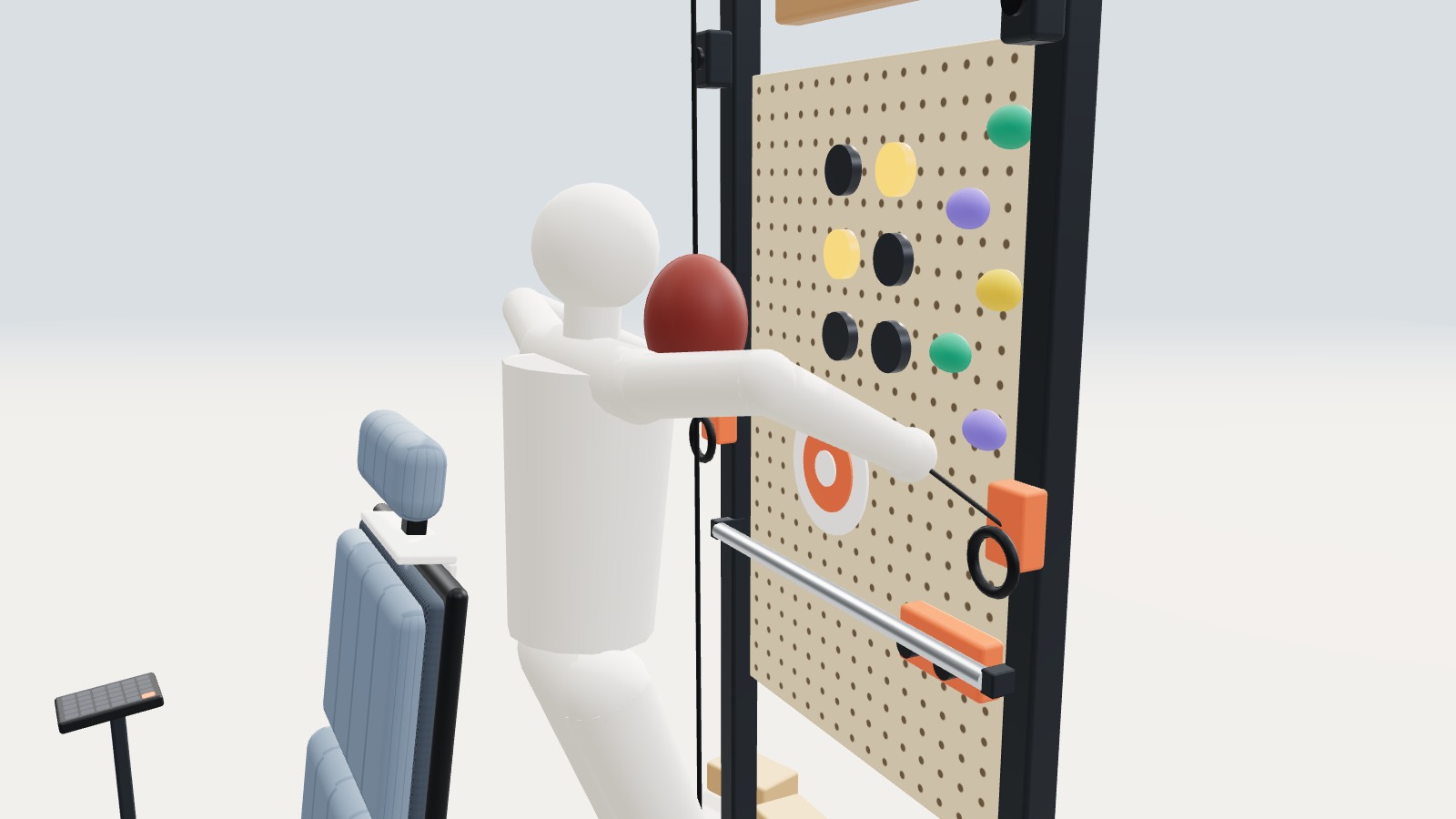
- 9Play wall. Hangboard, climbing holds, reaction lights, bag and grip station.
- 10Hang bar rated to 150 kg.
- 11Push rail at 1.0 m for incline push-ups, supported squats and yoga balance poses.
- 12Laptop tray clipped to the desk front, a little lower than the desk. Type on the laptop or the compact keyboard beside it, and use its screen as a fourth display.
- 13Small speakers on the front gantry posts and the rear columns, not on the desk.
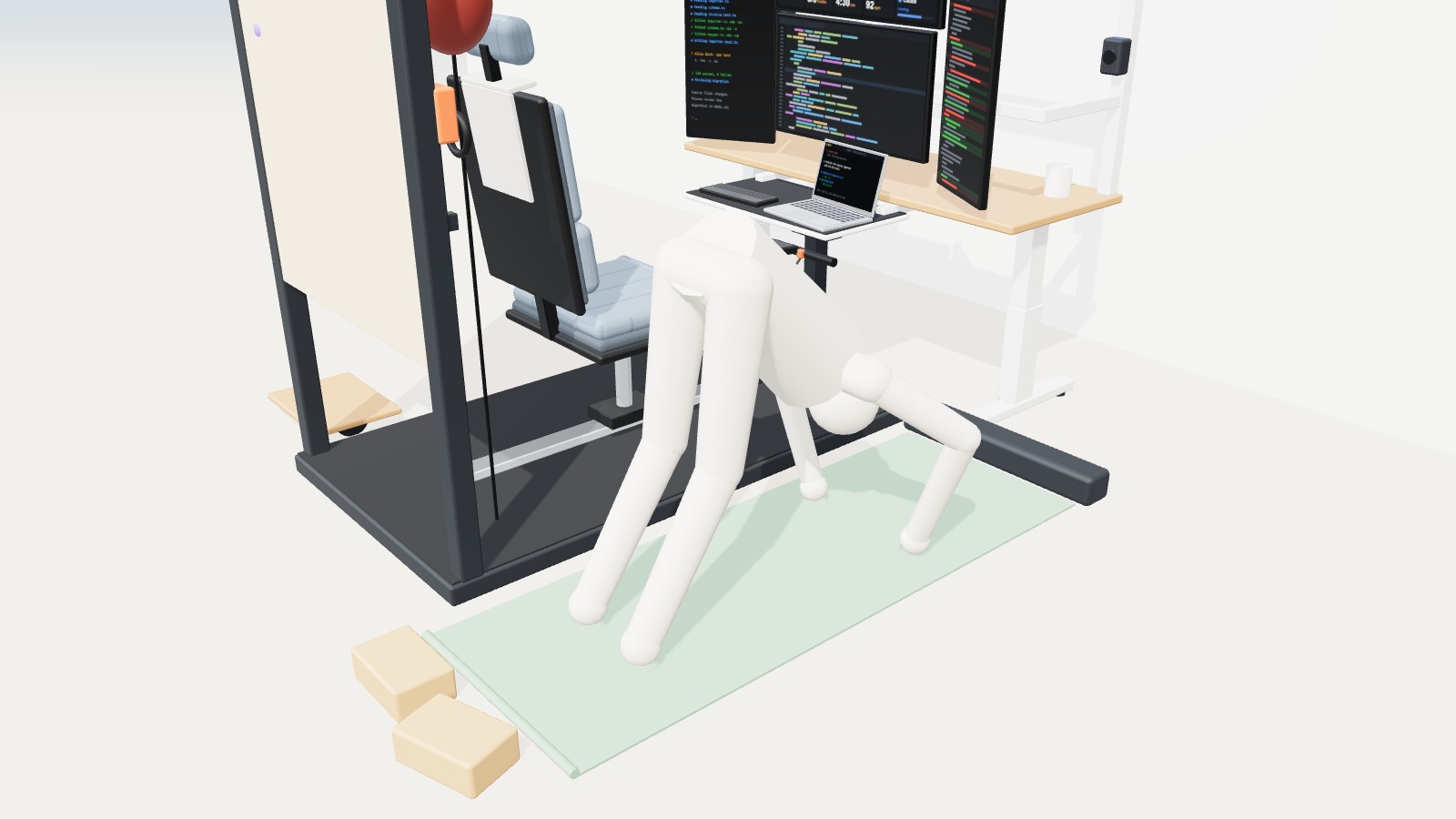
- +Yoga lane. A mat rolls out along the side of the platform (see floor plan).
Nine minutes of agent time, spent moving
Claude Code hooks report each state change: a prompt sent, a tool in use, a permission needed, a finished run. The box turns those events into light, voice and a workout sized to the time you have.
It talks you through both workouts: yours and Claude's
You wear a light boom headset, or rely on the shock-mounted mic array. The box speaks when something changes and stays quiet otherwise. Ask it anything with push-to-talk.
What you hear during the run above
- 10:05Box
Typical run here is about eight minutes. Race is on: two kilometers.
- 22:30Box
One kilometer down. Claude is editing files, about a third of the way through.
- 34:10Box
Claude needs you. It wants to run npm test. Finish your set, then take a look.
- 46:00You
Status?
BoxTests are running. You're ahead. Twelve more rows, then the reaction lights.
- 58:40Box
Claude is done in billing-service. Twelve files changed, all tests pass, and it wants you to review the migration. You won round nine.
Where its information comes from
- Claude Code hooks for each prompt, each tool in use (reading, editing, running tests), each permission request and each finished run.
- The session transcript. A small, fast model turns Claude's last message into one spoken sentence.
- The wait log, which learns the typical run length for each project. That's how it knows "about eight minutes."
- Sensors: pedal cadence and power, cable reps, webcam rep counting, reaction-light times.
- You, asking things like "status?", "how many squats do I owe?", "give me a five-minute flow" or "pause coaching."
Yoga flows
- It leads flows by voice, sized to the expected wait, with a breath count for each pose.
- The LED strip slowly brightens and dims at breathing pace, about six breaths a minute. It stays blue while Claude runs and switches to amber the moment Claude needs you.
- The webcam rep counter doubles as a gentle pose guide ("hips level", "soften the knee"). It gives cues, not corrections.
House rules
- It speaks when something changes, never as running commentary.
- "Needs you" comes first. Coaching waits.
- During calls and quiet hours it speaks only through the headset.
- It never approves a command by voice. Approval takes a look at the exact command on the status bar and a firm press of a physical button.
Race the agent
A thin status strip along the top of the main monitor. Each session gets a tile. In the middle, your pedaling races Claude's estimated progress. While you exercise it switches to workout stats: cadence, watts, distance, heart rate, reps and breaths. This demo runs on sample data.
Five modes, one footprint
Work
Any wait · seated or standingSeat locked, laptop on the tray. Pedal lightly while you type, or swing the pedals aside and rest your feet flat.
Yoga
30 seconds to 15 minutesSeated stretches in the work seat, standing balance poses with a hand on the push rail, and full flows on the mat that rolls out beside the platform.
Pedal
3 to 8 minutesIntervals against the agent: 30 seconds hard, 30 easy. You can stop the instant the light turns amber.
Row
5 to 15 minutesFold out the footplates, unlock the rail, pull the handle from the mast. A full-body pull that reverses a day of hunching.
Strength and play
30 seconds to 15 minutesCable presses and rows, dead hangs, climbing holds, reaction-light games and the bag.
Rowing mode
The pedal flywheel does double duty. A spool with a one-way clutch sits on the same axle.
The play wall
A peg grid between the cable columns. Modules snap in and out, so the wall changes with you. Yoga blocks and a strap hang on the pegs too.
Movement menu
The status bar suggests one of these from the typical wait for that project. Each is chosen to undo something a day at the keyboard does.
| Expected wait | Move | Or yoga | Why |
|---|---|---|---|
| Under 1 min | Stand up, 15 calf raises, look at something 6 m away for 20 seconds | Seated twist, neck release and wrist stretches in the work seat | Breaks up sitting and rests the eyes and hands |
| 1 to 3 min | Band pull-aparts ×15, face pulls ×12, 30-second dead hang, one reaction-light round | Tree and dancer pose with a hand on the push rail, standing forward fold | Counters rounded shoulders and trains balance |
| 3 to 8 min | Pedal race or intervals, 30 seconds hard and 30 easy | Three rounds of sun salutation on the mat | Raises the heart rate and moves every joint |
| 8 to 15 min | Row, or a circuit: squats, cable press, cable row, split squats | Hip flow: low lunge, pigeon, downward dog, child's pose | Opens hips that sitting shortens |
| Amber light | Finish the rep, not the set, and walk back | Finish the breath, not the flow | An idle agent waiting on you costs more than a missed set |
Screens that stay put while you move
Floor plan
Seen from above, with the desk at the top.
The dashed outline near the desk is the laptop tray, which sits above the pedal unit. The yoga mat rolls out of a cassette along the side of the platform and rolls back in when you're done. Allow about 0.6 m of clearance around the rig and 2.3 m of ceiling for hangs and overhead reaches.
Vibration strategy, most important first
- Separate frames. Walking steps (about 2 Hz) and pedal strokes (1 to 1.5 Hz) are too slow for any rubber pad to absorb. A structural gap is the only real cure.
- A stiff quiet frame. Keep its lowest natural frequency above 10 Hz with a closed-section beam, a brace and damping tape. Short rigid monitor mounts instead of long gas-spring arms, which sway at 3 to 6 Hz.
- Isolated feet. Molded elastomer pads under both frames absorb the 10 to 100 Hz buzz of footfalls and the flywheel.
- Careful electronics mounting. SSD-only computer on elastomer grommets, shock-mounted mic, slack service loops at every connector.
- The right floor. Concrete is ideal. On a wood-joist floor, choose pedaling over a walking pad.
Short, frequent movement adds up
Studies of breaking up long sitting with a few minutes of light activity every half hour show better blood sugar and insulin response after meals (Dunstan et al., Diabetes Care, 2012). Agent waits supply those breaks without scheduling them. The movement menu also targets what a day of coding does to a body.
Shoulders and neck
Face pulls, rows and dead hangs counter rounded shoulders and a forward head.
Hands and forearms
Finger-extension bands, grippers and climbing holds balance muscles that typing overuses.
Hips
Lunge stretches, split squats and rowing open hip flexors that sitting shortens.
Eyes and focus
Ball tosses, reaction lights and far-focus breaks rest eyes locked at screen distance.
Breath and balance
Slow, light-paced yoga breathing and rail-supported balance poses give a calm reset before you review Claude's work.
Design targets
| Footprint | 2.0 m wide including the yoga lane × 2.45 m deep. Allow 0.6 m clearance around. |
|---|---|
| Ceiling | 2.3 m for dead hangs and pull-ups |
| Desk | 1600 × 600 mm top, dual-motor lift, 64 to 129 cm |
| Computer | Your laptop, on a tray clipped to the desk front a little below desk height, with a compact keyboard beside it. It works as a fourth screen. One USB-C or Thunderbolt cable to a dock under the desk drives the monitors, status bar, mic and controller. |
| Screens | 32" 4K center, two 27" portrait, a thin status strip (about 75 × 10 cm) on top of the main monitor, all held forward at the desk front edge so your eyes are about 0.9 m from the main screen while seated. Bring your own VESA displays. |
| Quiet frame | Stiff gantry with lowest natural frequency above 10 Hz. Two short braced arms carry the monitor beam forward to the desk front edge. |
| Motion frame | Steel platform, 1000 × 1800 mm, in two bolted halves |
| Cardio | Recumbent magnetic flywheel, 8+ levels, under 40 dB, Bluetooth cadence and power. It rides a swing arm pinned at the front corner of the platform, so it swings out beside the seat when you want your feet flat. |
| Rowing | Cable spool with one-way clutch on the same flywheel. Fold-out footplates on the flywheel housing. |
| Seat | Elastomer suspension mesh over a contoured pan with sit-bone hollows and a rounded front edge that doesn't press behind the knees while you pedal. A quiet fan under the seat pulls air through whenever you're moving. Mesh doesn't soak up sweat and dries in minutes; a thick snap-on, machine-washable pad adds cushioning for long sessions. The backrest has a separate lumbar pad and a headrest for leaning back while you review. The seat lifts off its post for rinsing. Towel hook on the backrest. Rides a 1.2 m rail: locked, free-sliding, or parked. |
| Keyboard | Split halves on seat-mounted swing arms with magnetic detents |
| Cable columns | Two 2.15 m columns. Carriage at 10 heights, 2 to 30 kg per side in 2.5 kg steps, 1.2 m travel, enclosed constant-force springs. |
| Hang bar | Rated 150 kg, proof-tested to 2 to 3 times that |
| Push rail | 1.0 m high, for incline push-ups and supported squats |
| Play wall | Peg grid between the columns for snap-in modules |
| Yoga lane | 0.66 × 1.83 m natural-rubber mat on a spring roller cassette along the platform side. Two cork blocks and a strap stored on the play wall pegs. |
| Isolation | 15 mm air gap between frames; molded elastomer feet under both |
| Audio | Boom headset, shock-mounted beamforming mic array, and four small satellite speakers: two on the front gantry posts and two on the rear cable columns, so voice cues reach you anywhere on the rig. |
| Controller | ESP32-class board: LED strip, fan, cadence, button pad, reaction lights; USB and Bluetooth |
| Software | Claude Code hooks, status bar app, voice coach, wait log |
| Finish | Marine-grade powder coat and stainless fasteners, suited to salt air and sweat |
| Shipping | 9 parcel boxes, none over 30 kg |
| Assembly | About 90 minutes for two people with one 6 mm hex key. Keyed connectors on every cable. |
Start small, add modules
Concept pricing targets, not quotes.
Gym Busy Box Kit
Controller board, LED strip, status bar software, voice coach, and one cable column on a floor plate. Pairs with the desk and under-desk bike you already have.
Gym Busy Box
The full two-frame rig: lift desk and gantry, motion platform, pedal flywheel, seat rail, swing-arm keyboard mounts, two cable columns, push rail, hang bar, and the yoga lane with blocks and strap. Screens not included.
Gym Busy Box Arcade
Everything in Gym Busy Box, plus the play wall modules, rowing spool, reaction lights, wobble board, and the webcam rep counter with yoga pose cues.
Built from parts factories already make
Buy or make
- Buy: lift columns from standing-desk suppliers, the flywheel unit from fitness contract makers, the seat and linear rail, the keyboard arms. Customers bring screens and headset.
- Make: the platform halves, cable columns, spring cassettes, gantry beam and one controller board.
- Designed for flat-pack. Tab-and-slot laser-cut plates, one tube profile, one bolt size, keyed wiring.
- Accessories keep selling. New play wall modules ship in small boxes and snap into grids owners already have.
Production path
- 10 to 100 units. Laser-cut, bent and welded by job shops; T-slot aluminum gantry. No tooling cost.
- 1,000 to 10,000. Robot welding, a custom extrusion die, roll-formed columns and injection-molded handles. About $100k to $250k in tooling.
- 10,000 and up. A fitness contract manufacturer builds and boxes the whole unit.
Certification: ASTM F2276 and ISO 20957 (fitness), BIFMA X5.5 and UL 962 (furniture with a powered lift), FCC Part 15 (controller). Hang bar and columns are load-tested to 2 to 3 times rating.